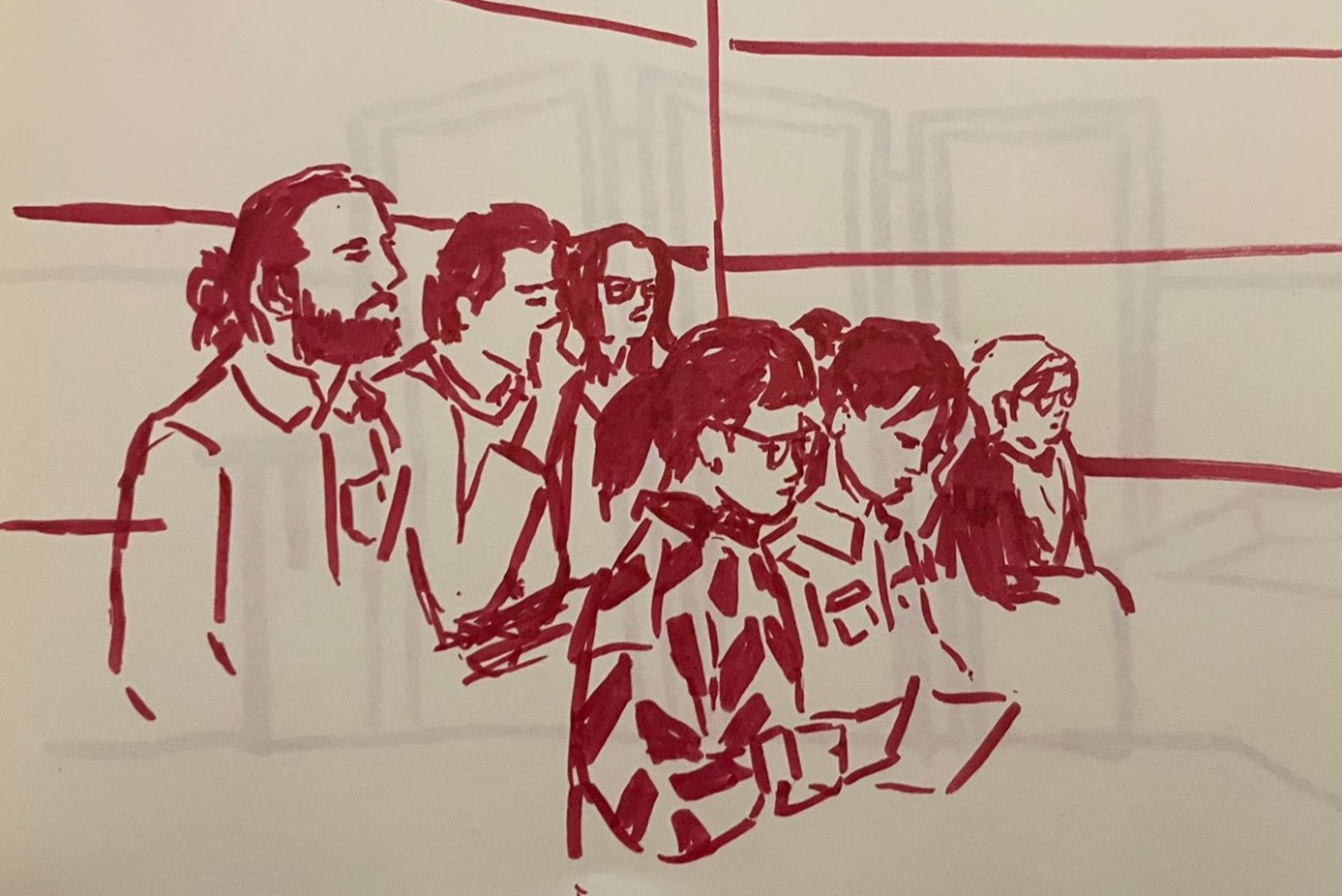
The first closing speech by the defence at the Filton trial was by Rajiv Menon KC, as the lead barrister, representing the first defendant Charlotte Head.
It was a powerful speech. Here are the highlights, based on our own notes as we watched from the public gallery, and Real Media’s excellent coverage which you can read for the details.

“Rajiv has a particular interest in cases involving human rights violations, miscarriages of justice, political protest and the abuse of power by the state. He was instructed in the Stephen Lawrence Inquiry, the Hillsborough Inquests, the Grenfell Tower Inquiry and the UK Covid-19 Inquiry” – Garden Court Chambers
A remarkable woman
Mr Menon began with the suffragettes.
“They understood that men would never give women the vote unless forced to do so. Asking politely was a waste of time. They organised large marches and rallies and engaged in civil disobedience and direct action. They vandalised property, chained themselves to buildings, and disrupted political meetings. When imprisoned, they went on hunger strike, leading to brutal force feeding by the authorities.”
He went on to describe how the suffragettes are celebrated today. Yet in their time, the mainstream press denounced them as extremists and terrorists.
The suffragettes are celebrated today. Yet in their time, the mainstream press denounced them as extremists and terrorists
Mr Menon said that like these remarkable women, Charlotte (Lottie) Head is a remarkable woman. He summed up her story as told during her evidence, including her selfless volunteering for three years in Calais, her work with victims of domestic abuse in London, and after October 2023, how she became involved with the campaign on Hackney Council to divest from the arms trade and Israel.
His voice broke with emotion as he said her decision to sacrifice years of her life and her education to serve others would make any parent proud.
Failure of democracy
Rajiv said it was unfair of Ms Heere in her closing speech for the prosecution to describe Lottie as a ‘lady in a hurry’ because of the short time between training with Palestine Action and the Filton action. She had in fact been trying for years to effect change within the system.
She had in fact been trying for years to effect change within the system
In the Hackney campaign, where she slept several nights a week at the encampment, she spent weeks helping activists put together a presentation to the council on why they should divest from Israeli arms firms. The council let them speak but then immediately announced their predetermined decision not to divest. They had tried the democratic route to challenge UK complicity in Israel’s genocide, and it had been a complete waste of time.
On the case as a whole, Mr Menon set out five initial points to the jury.
- Palestine, and Israel’s attack on Gaza
The two years of atrocities in Gaza should not be set aside in the jury’s minds, as this had come up in defendants’ evidence in the trial.
“You may think it would be wrong, even perverse, to ignore that evidence that you’ve heard about the killing and destruction that has been taking place in Gaza now for over two years.
How can you assess the defendants’ characters, their credibility, their conduct at Filton or their states of mind at critical times in the chronology that ended in that action? How can you assess that if you ignore the wider context of what has been happening in Gaza and the impact that those events have had on these defendants?”
- Palestine Action
Mr Menon said he agreed with the judge that the ‘elephant in the room’ – the proscription of Palestine Action – was not relevant to this trial. Its illegality (decided long after the Filton action) should not be held against the defendants.
He also pointed out that there was no mention of using violence in any of the planning document, that Palestine Action had carried out hundreds of nonviolent actions, and rejected the prosecution’s suggestion that violence was referred to in these plans without being ‘explicit’.
- Elbit Systems
Mr Menon reminded the jury that on several occasions the judge had interrupted evidence about Elbit to say that it was not relevant to the trial – the judge had made a ruling to restrict this evidence – yet the limited amount that had emerged was ‘instructive’, and the prosecution did not say it was inaccurate or exaggerated.
“It might be important to take into account, indeed to remember at all times, that the target of this action was a massive weapons company that has played a critical role in the killing of tens of thousands of Palestinians, as opposed to, for example, a company that makes fluffy toys for children.
“the target of this action was a massive weapons company that has played a critical role in the killing of tens of thousands of Palestinians”
“How can you reach true verdicts according to the evidence if you ignore the unchallenged, uncontradicted evidence you’ve heard about this dreadful company?”
- How the Filton action went wrong
The prosecution stated that the action was ‘meticulously planned’. Mr Menon agreed that in some ways it was well planned, but in many ways ‘it did not remotely go to plan’. The six were inexperienced laypeople, not trained military personnel.
“The footage from inside of the factory makes that abundantly clear. What you see in that footage is chaos, not a carefully executed plan.
You see members of the red team trying to respond to the unexpected presence of security guards as best as they can by shouting, by swearing, by lighting flares, by holding their sledgehammers in such a way to try and look as intimidating as possible without actually using them as weapons of offence. But “a plan to use the sledgehammers to injure or incapacitate the security guards if necessary”? Please – that’s not what you can see in that footage.”
Listing things that went wrong, “The final thing to go wrong was Sam Corner striking Sergeant Evans on her back with a sledgehammer. Whatever the jury decides in relation to Count Four [Sam Corner’s charge], it should obviously never have happened… it was clearly not part of a plan”
- The missing Elbit CCTV footage
At the start of the trial the jury were given a plan of the factory with numbered CCTV cameras printed on it. Mr Menon pointed out that they later received the same plan with four additional cameras – 22 to 25 – handwritten on it. This was because the existence of these cameras only emerged during examination of the prosecution witnesses, and the defence team had to ask about the missing footage.
Cameras 22-24 cover areas where there was activity, including the alcove in which guard Angelo Volante interacted with several defendants.
Footage from these cameras was not downloaded by Detective Sergeant Sarah Grant when she went to the Elbit factory the day after the action. Mr Menon felt it was unlikely that this experienced police sergeant failed to notice that these particular cameras had recorded relevant activity. He felt the only other possibility was Elbit withholding the footage. But the prosecution then failed to call on anyone from Elbit as a witness to explain its disappearance.
“No Elbit witness has been called. The security guards, you will remember, were not employed by Elbit directly. They were employed by another company.
So Elbit remains in the shadows, hidden and protected, but not, ladies and gentlemen, in the corridors of power where no doubt they are welcomed, wined, and dined, whilst Charlotte and all the other co-accused in this case have been denied bail and have been locked up for 17 months.”
“No Elbit witness has been called. The security guards, you will remember, were not employed by Elbit directly. They were employed by another company.
So Elbit remains in the shadows, hidden and protected, but not, ladies and gentlemen, in the corridors of power where no doubt they are welcomed, wined, and dined, whilst Charlotte and all the other co-accused in this case have been denied bail and have been locked up for 17 months.”
After lunch, Mr Menon spoke on each of the three counts his client Lottie, and all six defendants, are charged with.
Count one: Aggravated burglary
Mr Menon started by suggesting that the charge of aggravated burglary, “this most serious of criminal charges”, given the evidence in the case, amounts to “deliberate prosecutorial overkill”.
The charge of aggravated burglary is “deliberate prosecutorial overkill”
According to the judge’s route to verdict, to find Lottie guilty, the jury would have to answer yes to this question:
“Are you sure that Charlotte had with her a sledgehammer, which at the time of entering the building, she intended to use to cause injury to or incapacitate a security guard if needed, or encouraged or assisted a co-defendant to have with them a sledgehammer, which at the time of entering the building, they both intended to be used by the co-defendant for that purpose?”
Breaking the question down, Mr Menon said they must be sure, beyond reasonable doubt, about Lottie’s intentions. And the focus is on her intentions at the point she entered the building, not any intention she may have formed later during the action. And the intention must be to injure or incapacitate – “an intention only to frighten or scare a security guard with a sledgehammer” is not enough.
Mr Menon made a number of arguments about the lack of evidence for any of this. They included:
Lottie’s good character
Given everything the court has heard about her, including her commitment to nonviolence, “It’s nonsensical to suggest that someone like her would have signed up to a plan involving the use of violence to injure or incapacitate a security guard with sledgehammers if the need arose. Everything you know about her suggests the contrary, namely that she would never have signed up to that kind of plan.”
The activists had all clearly stated they had ‘red lines’ they would not cross and were committed to nonviolence.
“To convict Charlotte of aggravated burglary, you would have to be sure that all of what she told you about her commitment to nonviolence was an elaborate lie”
“To convict Charlotte of aggravated burglary, you would have to be sure that all of what she told you about her commitment to nonviolence was an elaborate lie, and that in truth she would have been perfectly prepared to strike a security guard with a sledgehammer to injure or incapacitate if the need arose. With all due respect, how could you possibly reach that conclusion?”
Palestine Action
“You’ve heard evidence from Charlotte and the other defendants about the hundreds of previous actions by Palestine Action over the years, in relation to the absence of violence. Why on earth would they suddenly, after years, abandon nonviolent direct action and embrace a wholly different approach involving planned violence with sledgehammers against security guards?” Given their mass popular support, “Using violence against security guards would have been completely antithetical, completely contrary to the aims, objectives of this organisation and their strategy of nonviolent direct action, and not to mention utterly counterproductive.”
He concluded, “the only just verdict on the count of aggravated burglary is one of not guilty.”
Count two: Criminal damage
The indictment says: “that on the 6th August 2024, the defendants without lawful excuse, destroyed or damaged property belonging to Elbit Systems UK Ltd, intending to destroy or damage such property or being reckless as to whether such property would be destroyed or damaged.”
Lawful excuse
Here, Mr Menon referred to an ‘excellent’ question asked by a member of the jury earlier in the trial:
“If we decide that they genuinely believe that they were performing life-saving action and were morally compelled to destroy weapons they believed were going to be used to kill civilians in what they believe to be an illegal genocide, would that amount to a lawful excuse?”
He then quoted Justice Johnson’s legal directions to the jury on this question:
‘As I told you when you asked a question about this, if a defendant believed that they were morally justified in doing what they did to prevent what they thought was a genocide, then that would not amount to a lawful excuse. There is no evidence in this case of anything that is capable in law of amounting to a lawful excuse, so that is not something that you need to consider’.”
Mr Menon explained: “So it boils down to this. However strange it might seem, given the facts of the case are solely for you, judges are entitled, as a matter of law in our system, to withdraw defences from the consideration of the jury if they conclude that there is no evidence to support the defence. And that is what His Lordship has done in this case…His Lordship, as a matter of law, has withdrawn the defence of lawful excuse from your consideration.”
“His Lordship is not directing you to convict”
He went on to clarify what this means for the jury: “You could be forgiven for thinking that His Lordship is in fact directing you… to convict Charlotte, who I’ll focus on for now, of criminal damage. But you’d be wrong to think that. His Lordship is not directing you to convict. In fact, not only is he not directing you to convict, but he’s also absolutely forbidden from doing so as a matter of law. … No judge in any criminal case is allowed to direct a jury to convict any defendant of any criminal charge, whatever the evidence might be. That is the law.”
The case of Penn and Meade
Then Mr Menon told the story of a trial in 1670, when Quakers William Penn and William Meade were prosecuted for preaching to a gathering outside of a Church of England building, which at the time was unlawful. The jury was directed by the judge to find them guilty and the jury refused. They returned a verdict of not guilty.
According to Mr Menon, “The judge remanded the entire jury in custody for two days and ordered that they be denied all food and water. As the jurors were being taken from court to prison, William Penn, it is said, shouted out, “You are Englishmen, mind your privilege, give not away your right”, to which one member of the jury, Edward Bushel, replied, “Nor shall we ever do.” When the jury returned to court two days later, having not had any food or water for that period, the judge again ordered them to convict. The jury continued to refuse and returned a verdict of not guilty.
The judge fined the jury for contempt of court and remanded them in custody until the fines were paid. Eight jurors paid their fines, but four refused, and one of those was Edward Bushel, who then petitioned a higher court for what is called a writ of habeas corpus, which, if issued by the court, would result in his immediate release from custody. The higher court issued that writ, and Edward Bushel and the three others were released, establishing the right of a jury to return a verdict without fear of punishment from the trial judge.”
“Chief Justice Vaughan delivered the opinion of the court, which established the right of juries to give their verdict according to their convictions”
A marble plaque inside the Old Bailey commemorates this celebrated case, with an inscription ending in the words “Chief Justice Vaughan delivered the opinion of the court, which established the right of juries to give their verdict according to their convictions.”
Mr Menon concluded, “Putting that all together, members of the jury, you can find Charlotte and her co-defendants not guilty of criminal damage. It is a perfectly fair and proper verdict for you to return in this case.”
Count three: Violent disorder
Mr Menon explained, “The legal directions tell us that a person is guilty of violent disorder if they are present together with two or more people, that they used or threatened unlawful violence or assisted or encouraged at least three people to do so, intending those people to use or threaten unlawful violence, and if the conduct of the group taken together would cause a person of reasonable firmness at the scene to fear for their personal safety.”
The hypothetical bystander
Among other points, Mr Menon took time to explain to the jury the words ‘a person of reasonable firmness at the scene’. This person is not one of the people involved in the events of that night – not an activist or a security guard – but a ‘hypothetical bystander’. Would that person fear for their personal safety?
Mr Menon pointed out that the bystander would not see just the footage compiled by the prosecution. They would see everything that happened inside the factory that night.
“The hypothetical bystander would see that there were three burly male security guards and six young people dressed in red, four of whom were relatively small young women, present inside the factory. They’d see that one of those security guards, namely Angelo Volante, putting it as neutrally as I can, was aggressive, if not violent, towards those in red. They’d see that a number of the women in red had real trouble holding the sledgehammers, let alone swinging them when damaging property, because they were heavy. They’d see that several of the individual confrontations taking place inside the factory never became physical and merely involved lots of shouting and/or swearing.
“The hypothetical bystander would see that there were three burly male security guards and six young people dressed in red, four of whom were relatively small young women”
The hypothetical bystander would see one of the men in red, Mr Devlin, unarmed, trying to de-escalate the situation over time, and get one of the security guards, namely Mr Volante, who was armed with a sledgehammer, to calm down and leave. They’d see that most of those in red were single-mindedly focused on damaging as much property as possible, and were not a threat or a danger to them. The hypothetical bystander would see that although the people in red were on occasion armed with sledgehammers or crowbars, they were not in fact using them as weapons of offence against the security guard.”
A poem from Gaza
Finally, Mr Menon read the court a poem, after a short introduction to the poet.
“Refaat Alareer was a Palestinian poet, academic and activist… He lived in Gaza. He was married, he had six children. On the 6th of December 2023, he was killed, together with six other members of his extended family, in an Israeli airstrike, which has been widely reported by the international media as having been a deliberate surgical targeting of an apartment where he was staying. Refaat Alareer was 44 years old.
I want to end by reciting what has become Refaat Alareer’s most famous poem, as it so beautifully encapsulates in a way that I could never replicate, not only the Palestinian tragedy, but also the hope for a better future, both of which lie at the very heart of this case. The poem is called ‘If I Must Die’.”
If I must die,
you must live
to tell my story
to sell my things
to buy a piece of cloth
and some strings,
(make it white with a long tail)
so that a child, somewhere in Gaza
while looking heaven in the eye
awaiting his dad who left in a blaze–
and bid no one farewell
not even to his flesh
not even to himself–
sees the kite, my kite you made, flying up above
and thinks for a moment an angel is there
bringing back love
If I must die
let it bring hope
let it be a tale
End the nightmare
This is how Mr Menon finished his speech:
“Enough is enough.
Please, find Charlotte not guilty of aggravated burglary, criminal damage and violent disorder. These are fair and proper verdicts to return in her case. Acquit her so that she does not have to spend another day locked up behind bars.
Set her free. End the nightmare. Please. Enough is enough. Thank you so much for listening to me.”
The closing speeches of the five other defence barristers will be reported on Real Media. The court expects the jury to start deliberating on Tuesday 13 January.
To get updates in your inbox, sign up to our newsletter