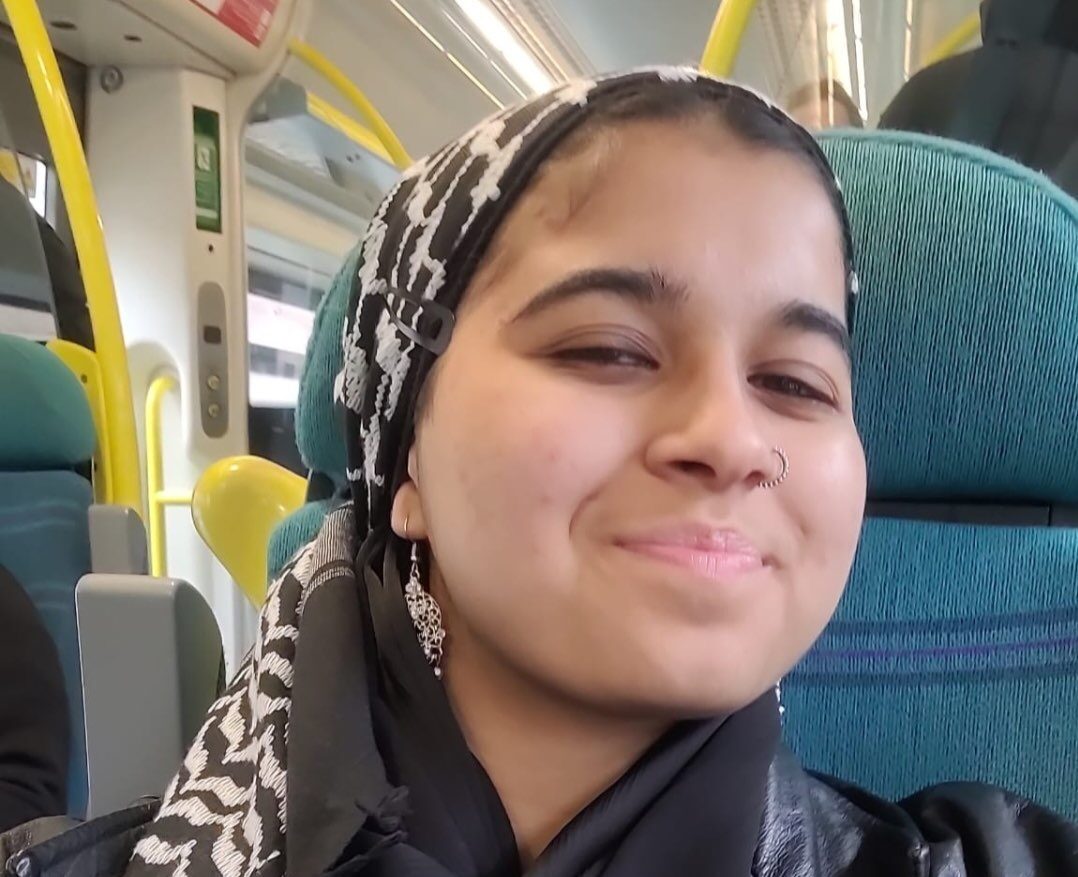
On April 29th we heard the closing defence speeches of the Filton 6 retrial, with all defendants except Sam choosing to dismiss their lawyers and represent themselves. Corner, remained represented in court, by barrister Tom Wainwright.
Here is Fatema Zainab’s closing speech:
Good morning, members of the jury. You have heard from me once already. I apologise if I seem a bit nervous. This is my first time doing anything like this. It is a bit of a nerve-wracking situation. As many of you already know, this type of closing speech is usually given by a defence barrister who is a legal expert. And again just to reiterate what Lottie and Ellie (Charlotte and Leona) have already said, I did not fire my barrister. I simply wanted to speak to you as an ordinary person, and I wanted to take this chance to speak to you, not in legal terms or arguments, but as an everyday person just like you.
My name is Fatema Zainab Rajwani. I am 21 years old. I have no previous convictions or cautions to my name. I was born in Dar es Salaam in Tanzania, which is just on the coast of East Africa, to a British Asian mother and an African Asian father. I spent my childhood there and I spent my childhood moving between London and Tanzania. I interacted with almost everyone from all walks of life. It taught me kindness, compassion and acceptance regardless of difference, regardless of what someone looked like or where they came from. It taught me that everyone, no matter who they are, deserves dignity and safety and respect – values that I still try to live my life by. It is these values I see enshrined into this country that has become my home. This country which has a beautiful, rich history of love and solidarity and descent, of women, queer people, and people of colour who fought bravely for those rights, so that people like us, people like me, be allowed to live, to work, to study, and most importantly, to have a right to a fair trial by a jury of our peers – by a jury of my peers in fact, as Mr. Wainwright just said, women weren’t even allowed to serve on juries until post-1920s, when the suffragettes fought for our right to be on a jury. And not until later than that, when we could be on a jury without restrictions that depended on property. And people of colour weren’t even allowed onto a jury until 1969, so I would have been lost on both counts to be able to judge someone of their character and of a crime that they had been accused of.
If not for people like them, two-thirds of the prosecution would not even be allowed to present their case to you – two thirds of it! And you are able to serve on this jury because people dared to imagine a better world. People believed that they could change it for the better, despite any opposition. And it is because of these people that have fought for us that we have one of the best, one of the most celebrated legal systems in the world. Because of our juries – because they are diverse and include 12 ordinary people from all walks of life who bring together their experience, their humanity, their compassion, to look at the facts of this case – any case – and judge them, and to deliver a verdict of the facts of the case as you see them to be. And you will go out very soon to make a choice – a very important, permanent choice – that has been entrusted to you by society and by us as defendants. And it is a choice that today, tomorrow, for as long as you live, you will have to stand by, and it will remain with you forever.
Over the last few weeks, you have heard lots of evidence from the prosecution, a whole sequence of events in multiple bundles. And you also heard from us.
In my case, you have heard that I am 21 years old – that I was 19 years old when I decided to take action with Palestine Action against Elbit Systems UK – that I had just turned 20 when that prison van crashed through the shutters of Elbit’s newest research and development facility in Filton in Bristol. You have heard about the GoPro I had strapped to my helmet, I told you, to document the fact that Elbit was making these drones, these killer drones in these factories. You’ve heard me – in that witness stand – own up to disarming those drones because they were going to kill children. And I told you how I was sick of waiting for the government to dig this well for me. I used this quote that I was done waiting for someone to dig a well for me. I decided to dig the well myself. And I meant by that, instead of waiting for these weapons to stop, I went straight to the source.
You’ve heard how I was still just barely 20 when we were arrested in that factory and then re-arrested again under the Terrorism Act, and still despite not being charged with any terrorism-related offences, when we were subsequently held without communication with our families for weeks, for weeks on end at 20. I’d never lived out of home previous to that, by the way. That was the longest I’d ever gone without speaking to my mother. And then subsequently imprisoned. [Fatema took a moment to regain composure, tearing up at this time.]
The prosecution has told you that there’s no dispute about the fact that there was damage caused, but that is regardless of the fact that not a single witness from Elbit was called and you’ve heard this from other people. Not a single witness from Elbit was called to confirm that damage, to corroborate that story. Nor was an inventory produced of the damage caused. So how can you be sure? How can you be sure without any cold, hard facts that the prosecution have convinced you beyond reasonable doubt, members of the jury, that this damage, although by our own admission was caused, was really and truly criminal damage? Again, without proof of fact to even corroborate it. Where in evidence has the prosecution shown anything beyond a few disarmed weapons, some paint, and an endless tirade of increasing security violence?
The simple fact, members of the jury, is that the prosecution has failed to fulfill their burden of proof to a criminal standard. They did not even seek to adduce numbers, or cold hard facts, relying instead on an admission from us rather than their own witnesses, while simultaneously calling us irresponsible and stating that we are refusing to take accountability. You’ve heard the thinly veiled criticism from the prosecution about exercising our right to plead not guilty, and it is a right to plead not guilty. They have presented this to you as a way to put the blame on us, to say that we have refused to take responsibility for our actions. When each and every one of us has stood in that witness box, not once, multiple times, to attest to what we did within that factory, each one of us has told you that we volunteered to be accountable for our actions, that we were willing to do a high level arrestable action that would lead us right here all these months later to stand in front of you.
We knew we were going to end up here in front of you all, that we went into this action to be held accountable by you. And I’m not ashamed, I am not ashamed to stand here before you. On the contrary, it is my privilege and my honour to stand trial for disarming Israeli military drones. It is my honour to stand in front of you as someone who has told you from this stand that the belief that drives their life is simple, that to save one life is to save all of humanity.
And you are 12 ordinary people – my peers in society, who today act as the backbone of our legal system.
I do not wish to try and prove my innocence, as it is not my job to. It is the job of the Crown to provide evidence beyond any reasonable doubt (which means if you have any doubt at all, you must find us not guilty), of my guilt. And it is my inalienable right, fought for by those before me, to stand in this courtroom and ask you to really think about whether the prosecution have actually proved my guilt, or have they hidden the fact that there is no way to find any of us truly guilty, behind prosecutorial overreach?
God knows how much of our tax money poured into on-screen animations. And even though they tried to explain it, the fact that they do not even have access to all of the CCTV and body-worn. All the might of the Crown could not produce that CCTV and those body-worn cameras, from everything that happened inside that factory.
Our pleading not guilty is not a way to shed responsibility or to avoid guilt. I’m going to say that again. Our pleading not guilty is not a way to shed responsibility and is not a way to avoid guilt. It is guilt that the prosecution has made incumbent on us, despite the fact that we have yet to receive a verdict – despite the fact that they have already failed to fulfil the burden and standard of proof, and yet seek to try and convince you that our guilt is foretold, that it has already been set in stone. They have predetermined your verdict and your decision and made it for you, and in doing so have taken away from you the fact that there are still two verdicts to return, guilty and not guilty. And the choice has been entrusted to you and to you only to find true facts of this case, based on the evidence you have heard in the witness box and what the prosecution has produced or failed to produce also. Thank you.